|
funkalicious 0.1
|
|
funkalicious 0.1
|
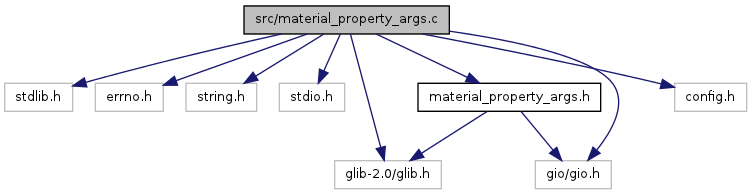
#include <stdlib.h>#include <errno.h>#include <string.h>#include <stdio.h>#include <glib-2.0/glib.h>#include <gio/gio.h>#include "material_property_args.h"#include "config.h" Include dependency graph for material_property_args.c:
Go to the source code of this file.
Defines | |
| #define | MATERIAL_PROPERTY_ARGS_DOMAIN 1026 |
Functions | |
| void | program_print_version (FILE *f) |
| void | libdotcode_print_version (FILE *f) |
| int * | vector_from_ints (char **ints, GError **err) |
| double * | new_double_from_string (const char *s, GError **err) |
| int * | new_int_from_string (const char *s, GError **err) |
| struct args * | process_args (int argc, char **argv, GError **err) |
Variables | |
| struct args | args |
| #define MATERIAL_PROPERTY_ARGS_DOMAIN 1026 |
Definition at line 39 of file material_property_args.c.
Referenced by new_double_from_string(), new_int_from_string(), process_args(), and vector_from_ints().
| void libdotcode_print_version | ( | FILE * | f | ) |
| double* new_double_from_string | ( | const char * | s, |
| GError ** | err | ||
| ) |
Definition at line 91 of file material_property_args.c.
References MATERIAL_PROPERTY_ARGS_DOMAIN.
                                                            {
  double* d = (double*)malloc(sizeof(double));
  if(d == NULL) {
    *err = g_error_new(MATERIAL_PROPERTY_ARGS_DOMAIN, 1, "material_property_args_args.c::new_double_from_string: Error occurred converting string (%s) to double: out of memory/malloc failed", s);
    return NULL;
  }
  char *end;
  errno = 0;
  *d = strtod(s, &end);
  if(((end == s) && (*d == 0)) || (errno != 0)) {
    *err = g_error_new(MATERIAL_PROPERTY_ARGS_DOMAIN, 2, "material_property_args_args.c::new_double_from_string: Error occurred converting string (%s) to double: %s", s, strerror(errno));
    free(d);
    return NULL;
  }
  return d;
}
| int* new_int_from_string | ( | const char * | s, |
| GError ** | err | ||
| ) |
Definition at line 108 of file material_property_args.c.
References MATERIAL_PROPERTY_ARGS_DOMAIN.
                                                      {
  int* d = (int*)malloc(sizeof(int));
  if(d == NULL) {
    *err = g_error_new(MATERIAL_PROPERTY_ARGS_DOMAIN, 1, "material_property_args_args.c::new_int_from_string: Error occurred converting string (%s) to int: out of memory/malloc failed", s);
    return NULL;
  }
  char *end;
  errno = 0;
  *d = strtod(s, &end);
  if(((end == s) && (*d == 0)) || (errno != 0)) {
    *err = g_error_new(MATERIAL_PROPERTY_ARGS_DOMAIN, 2, "material_property_args_args.c::new_int_from_string: Error occurred converting string (%s) to int: %s", s, strerror(errno));
    free(d);
    return NULL;
  }
  return d;
}
| struct args* process_args | ( | int | argc, |
| char ** | argv, | ||
| GError ** | err | ||
| ) | [read] |
Processes the arguments to process_args
| argc | argc from main |
| argv | argv from main |
Definition at line 125 of file material_property_args.c.
References args, e, args::file, libdotcode_print_version(), MATERIAL_PROPERTY_ARGS_DOMAIN, new_int_from_string(), PACKAGE_NAME, args::points, print_version(), program_print_version(), args::property, SIZEOF_DOUBLE, SIZEOF_INT, vector_from_ints(), VERSION, args::xslices, args::yslices, and args::zslices.
                                                               {
  int errored = 0;
  gchar **file_names = NULL;
  gboolean print_version = FALSE;
  gchar** xslices = NULL;
  gchar** yslices = NULL;
  gchar** zslices = NULL;
  gchar** points = NULL;
  GOptionEntry options[] = {
    { G_OPTION_REMAINING, '\0', 0, G_OPTION_ARG_FILENAME_ARRAY, &file_names,},
    { "version", 'v', G_OPTION_FLAG_OPTIONAL_ARG, G_OPTION_ARG_NONE, &print_version, "Print version information about this program", NULL },
    { "parameter", 'p', G_OPTION_FLAG_OPTIONAL_ARG, G_OPTION_ARG_STRING, &(args.property), "Property to be looked up across the structure (point is \"x,y,z\", in gridsites, e.g. -p=3,7,15)", NULL },
    { "at", 'a', G_OPTION_FLAG_OPTIONAL_ARG, G_OPTION_ARG_STRING_ARRAY, &(points), "point at which to output the specified parameter", NULL},
    { "xslice", 'X', G_OPTION_FLAG_OPTIONAL_ARG, G_OPTION_ARG_STRING_ARRAY, &(xslices), "x coordinate (in grid sites) along which to output a 2D map of the property across the slice of the structure", NULL},
    { "yslice", 'Y', G_OPTION_FLAG_OPTIONAL_ARG, G_OPTION_ARG_STRING_ARRAY, &(yslices), "y coordinate (in grid sites) along which to output a 2D map of the property across the slice of the structure", NULL},
    { "zslice", 'Z', G_OPTION_FLAG_OPTIONAL_ARG, G_OPTION_ARG_STRING_ARRAY, &(zslices), "z coordinate (in grid sites) along which to output a 2D map of the property across the slice of the structure", NULL},
    {NULL}
  };
  GOptionContext *ctx;
  ctx = g_option_context_new("- output a parameter at given points in the structure");
  g_option_context_add_main_entries(ctx, options, "Options");

  g_option_context_parse(ctx, &argc, &argv, NULL);

  args.xslices = NULL;
  int *d;
  GError *e = NULL;
  if(xslices != NULL) {
    for(int i=0; xslices[i] != NULL; i++) {
      if((d=new_int_from_string(xslices[i], &e)) != NULL) {
  args.xslices = g_list_append(args.xslices, d);
      }else{
  *err = e;
  return NULL;
      }
    }
  }
  args.yslices = NULL;
  e = NULL;
  if(yslices != NULL) {
    for(int i=0; yslices[i] != NULL; i++) {
      if((d=new_int_from_string(yslices[i], &e)) != NULL) {
  args.yslices = g_list_append(args.yslices, d);
      }else{
  *err = e;
  return NULL;
      }
    }
  }
  args.zslices = NULL;
  e = NULL;
  if(zslices != NULL) {
    for(int i=0; zslices[i] != NULL; i++) {
      if((d=new_int_from_string(zslices[i], &e)) != NULL) {
  args.zslices = g_list_append(args.zslices, d);
      }else{
  *err = e;
  return NULL;
      }
    }
  }
  args.points = NULL;
  e = NULL;
  int* vec;
  if(points != NULL) {
    for(int i=0; points[i] != NULL; i++) {
      if((vec=vector_from_ints(g_strsplit(points[i], ",", -1), &e)) != NULL) {
  args.points = g_list_append(args.points, vec);
      }else{
  *err = e;
  return NULL;
      }
    }
  }


  gchar* htext = g_option_context_get_help(ctx, FALSE, NULL);
  g_option_context_free(ctx);

  args.file = NULL;
  if(file_names != NULL) {
    if(file_names[1] != NULL) {
      *err = g_error_new(MATERIAL_PROPERTY_ARGS_DOMAIN, 101, "more than one grid to process was given!");
      errored=1;
    }
    args.file = g_file_new_for_commandline_arg(file_names[0]);
  }
  if(args.file == NULL) {
    *err = g_error_new(MATERIAL_PROPERTY_ARGS_DOMAIN, 101, "You must give a grid to process!");
    errored=1;
  }

  if(args.property == NULL) {
    *err = g_error_new(MATERIAL_PROPERTY_ARGS_DOMAIN, 102, "No property was given!");
    errored =1;
  }

  if(errored){
    printf("%s", htext);
    printf("\n\n**For version and compilation information, run with --version***");
    *err = g_error_new(MATERIAL_PROPERTY_ARGS_DOMAIN, 7, "\n");
  }
  if(print_version){
    program_print_version(stdout);
    libdotcode_print_version(stdout);
    printf("autotools info:\n\tProject: %s\n\tVersion: %s\n", PACKAGE_NAME, VERSION);
    printf("Platform information:\n\tSize of int=%d double=%d\n\tEndianness: %s\n", SIZEOF_INT, SIZEOF_DOUBLE,
#ifdef WORDS_BIGENDIAN
     "big"
#else
     "little"
#endif
     );
    if(*err == NULL) *err = g_error_new(MATERIAL_PROPERTY_ARGS_DOMAIN, 7, "\n");
    return NULL;
  }
  if(errored){
    return NULL;
  }
  return &args;
}
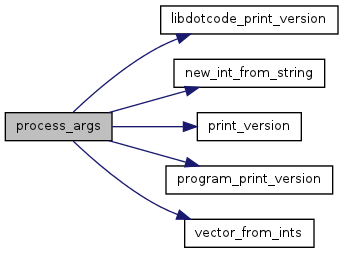
Here is the call graph for this function:| void program_print_version | ( | FILE * | f | ) |
| int* vector_from_ints | ( | char ** | ints, |
| GError ** | err | ||
| ) |
Definition at line 55 of file material_property_args.c.
References MATERIAL_PROPERTY_ARGS_DOMAIN.
Referenced by process_args().
                                                 {
  /*This little loop looks useless, but it counts the number of
    entries (not the termination condition)*/
  int i=0;
  for(i=0; ints[i] != NULL; i++);
  /*And then check the number of entries*/
  if(i != 3) {
    *err = g_error_new(MATERIAL_PROPERTY_ARGS_DOMAIN, 100, "Too %s vector components given (%d; expected %d)", (i<3)?"few":"many", i, 3);
    g_strfreev(ints);
    return NULL;
  }
  int* vec = (int*)malloc(3*sizeof(int));
  if(vec == NULL) {
    *err = g_error_new(MATERIAL_PROPERTY_ARGS_DOMAIN, 100, "Failed to allocated storage for 3 ints (the vector)");
    g_strfreev(ints);
    return NULL;
  }
  for(i=0; ints[i] != NULL; i++) {
    int val=-1;
    val = atoi(ints[i]);
    #ifdef DEBUG1
    fprintf(stderr, "ints[%d]=(%s) val=%d", i, ints[i], val);
    #endif
    if(val < 0) {
      *err = g_error_new(MATERIAL_PROPERTY_ARGS_DOMAIN, 100, "Got an invalid (negative) vector component: %d", val);
      free(vec);
      g_strfreev(ints);
      return NULL;
    }
    vec[i] = val;
  }
  g_strfreev(ints);
  return vec;
}
Here is the caller graph for this function: {
.file=NULL,
.property=NULL,
.points = NULL,
.xslices = NULL,
.yslices = NULL,
.zslices = NULL,
.check_cached=TRUE
}
Definition at line 41 of file material_property_args.c.
 1.7.3
1.7.3