|
funkalicious 0.1
|
|
funkalicious 0.1
|
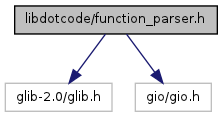
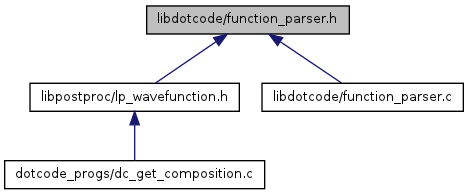
#include <glib-2.0/glib.h>#include <gio/gio.h> Include dependency graph for function_parser.h: This graph shows which files directly or indirectly include this file:
Go to the source code of this file.
Classes | |
| struct | wavefunc_header |
Functions | |
| int | read_wavefunction (char *filename, struct wavefunc_header *header, double **matrix, int *err) |
| int | read_wavefunction_gfile (GFile *f, struct wavefunc_header *header, double **matrix, GError **err) |
| double | get_binary_double (int le, char *buffer) |
| int | get_binary_int (int le, char *buffer) |
| int | parse_header (struct wavefunc_header *header, char *buff) |
| int | resilient_read (GFileInputStream *infile, char *buffer, int count, GError **err) |
| double get_binary_double | ( | int | le, |
| char * | buffer | ||
| ) |
Definition at line 317 of file function_parser.c.
References FILE_SIZE_DOUBLE.
Referenced by parse_header(), and read_wavefunction_gfile().
                                               {
  double value;
  char *ptr = (char*)(&value);
  int i, j;
#ifdef DEBUG2
  fprintf(stderr, "INFO: get_binary_double: le=%d, WORDS_BIGENDIAN=%d\n", le,
#ifdef WORDS_BIGENDIAN
    1
#else
    0
#endif
    );
#endif
#ifdef WORDS_BIGENDIAN
  if(!le) {
#else
  if(le) {
#endif
    /*Same endian-ness.  No conversion needed.*/
#ifdef DEBUG2
    fprintf(stderr, "INFO: get_binary_double: no need to convert endianness.\n");
#endif
    memcpy(ptr, buffer, FILE_SIZE_DOUBLE);
  }else{
    /*They're different.  We must bit-flip.*/
#ifdef DEBUG2
    fprintf(stderr, "INFO: get_binary_double: MUST convert endianness.\n");
#endif
    for(i=0, j=(FILE_SIZE_DOUBLE-1); i<FILE_SIZE_DOUBLE; ++i, --j) {
      ptr[i]=buffer[j];
    }
  }
  return value;
}
Here is the caller graph for this function:| int get_binary_int | ( | int | le, |
| char * | buffer | ||
| ) |
Definition at line 361 of file function_parser.c.
References FILE_SIZE_INT.
Referenced by parse_header().
                                         {
  int value;
  char *ptr = (char*)(&value);
  int i, j;
#ifdef DEBUG2
  fprintf(stderr, "INFO: get_binary_int: le=%d, WORDS_BIGENDIAN=%d\n", le,
    #ifdef WORDS_BIGENDIAN
    1
    #else
    0
    #endif
    );
#endif
#ifdef WORDS_BIGENDIAN
  if(!le) {
#else
  if(le) {
#endif
    /*Same endian-ness.  No conversion needed.*/
#ifdef DEBUG2
    fprintf(stderr, "INFO: get_binary_int: no need to convert endianness.\n");
#endif
    memcpy(ptr, buffer, FILE_SIZE_INT);
  }else{
    /*They're different.  We must bit-flip.*/
#ifdef DEBUG2
    fprintf(stderr, "INFO: get_binary_int: MUST convert endianness.\n");
#endif
    for(i=0, j=(FILE_SIZE_INT-1); i<FILE_SIZE_INT; ++i, --j) {
      ptr[i]=buffer[j];
    }
  }
  return value;
}
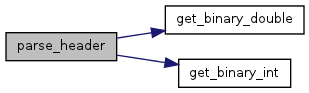
Here is the caller graph for this function:| int parse_header | ( | struct wavefunc_header * | header, |
| char * | buff | ||
| ) |
Definition at line 257 of file function_parser.c.
References wavefunc_header::dx, wavefunc_header::dy, wavefunc_header::dz, wavefunc_header::endian, wavefunc_header::energy, FILE_SIZE_DOUBLE, FILE_SIZE_INT, wavefunc_header::format, get_binary_double(), get_binary_int(), wavefunc_header::little_endian, wavefunc_header::Nc, wavefunc_header::Nx, wavefunc_header::Ny, wavefunc_header::Nz, wavefunc_header::version, and wavefunc_header::version_string.
Referenced by read_wavefunction_gfile().
                                                             {
  char *b=buff;
  /*First, we fill in the format and endianness info, since
   *   we will need for converting the ints and things.
   */
  memcpy(&(header->format[0]), b, 12);
  header->format[12]='\0';
  b += 12;
  header->endian = b[0];
  b++;
  header->version_string[0]=b[0];
  header->version_string[1]=b[1];
  header->version_string[2]=b[2];
  header->version_string[3]='\0';
  b += 3;
  /*Checks and fill in derive info (e.g. endianness int)*/
  if(strcmp(header->format, "CompWaveFxnb") != 0) return -1;
  if(header->endian == 'b') {
    header->little_endian=0;
  }else if(header->endian == 'l') {
    header->little_endian=1;
  }else{
    return -2;
  }
  if(header->version_string[0] != 'v') return -3;
  if(header->version_string[1] != '2') return -4;
  if(header->version_string[2] != '\n') return -3;
  else header->version = 2;

  /*Now fetch doubles and ints.*/
  header->Nc = get_binary_int(header->little_endian, b);
  b += FILE_SIZE_INT;
  header->Nx = get_binary_int(header->little_endian, b);
  b += FILE_SIZE_INT;
  header->Ny = get_binary_int(header->little_endian, b);
  b += FILE_SIZE_INT;
  header->Nz = get_binary_int(header->little_endian, b);
  b += FILE_SIZE_INT;

  header->dx = get_binary_double(header->little_endian, b);
  b += FILE_SIZE_DOUBLE;
  header->dy = get_binary_double(header->little_endian, b);
  b += FILE_SIZE_DOUBLE;
  header->dz = get_binary_double(header->little_endian, b);
  b += FILE_SIZE_DOUBLE;
  header->energy = get_binary_double(header->little_endian, b);
  b += FILE_SIZE_DOUBLE;

  return 0;
}
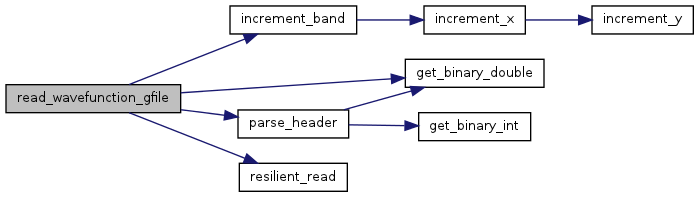
Here is the call graph for this function: Here is the caller graph for this function:| int read_wavefunction | ( | char * | filename, |
| struct wavefunc_header * | header, | ||
| double ** | matrix, | ||
| int * | err | ||
| ) |
Definition at line 90 of file function_parser.c.
References e, and read_wavefunction_gfile().
Referenced by main().
                                                                                                 {
  fprintf(stderr, "Got filename %s\n", filename);
  GFile* f = g_file_new_for_commandline_arg(filename);
  GError *e = NULL;
  int arr;
  arr = read_wavefunction_gfile(f, header, matrix, &e);
  if(e != NULL) {
    *err = e->code;
    fprintf(stderr, "function_parser::read_wavefunction(char*)<legacy>: Got error %d; message=%s\n", e->code, e->message);
    free(e);
  }
  return arr;
}
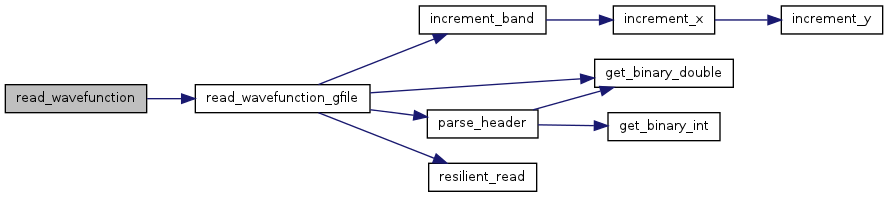
Here is the call graph for this function: Here is the caller graph for this function:| int read_wavefunction_gfile | ( | GFile * | f, |
| struct wavefunc_header * | header, | ||
| double ** | matrix, | ||
| GError ** | err | ||
| ) |
Definition at line 104 of file function_parser.c.
References DATA_BUFFER_SIZE, e, FILE_TO_APPEND, FUNCTION_PARSER_GERROR_DOMAIN, get_binary_double(), HEADER_SIZE, increment_band(), wavefunc_header::little_endian, wavefunc_header::Nc, wavefunc_header::Nx, wavefunc_header::Ny, wavefunc_header::Nz, parse_header(), POINT_SIZE, and resilient_read().
Referenced by load_wavefunctions(), and read_wavefunction().
                                                                                                     {
  GError *e=NULL;
  GFile *psifile = g_file_get_child(f, FILE_TO_APPEND);
  GFileInputStream *infile = g_file_read(psifile, NULL, &e);
  if(e!= NULL) {*err = e; return -3;}
  int count;
  GError *errn;
  char buffer[DATA_BUFFER_SIZE];
  int n_pts;
  int band;
  /*We allocate the matrix locally, so that we don't stomp on anything
   *unnecessarily. Kinda overkill, but whatever.*/
  double *mtrix;
  int pt;
  int ierr;
  char *bptr;
  int x, y, z;
  if((header == NULL) || (f == NULL)) {
    *err = g_error_new(FUNCTION_PARSER_GERROR_DOMAIN, 0, "function_parser::read_wavefunction_gfile: header and/or filename and/or matrix was NULL!");
    if(header == NULL)    return -1;
    if(f == NULL)  return -2;
    if(matrix == NULL)  return -5;
  }
  if((count = resilient_read(infile, buffer, HEADER_SIZE, &errn)) < HEADER_SIZE) {
#ifdef DEBUG3
    fprintf(stderr, "INFO: read_wavefunction: read in only %d bytes, not %lu (when reading header)\n", count, (long unsigned int)HEADER_SIZE);
#endif
    *err = errn;
    return -4;
  }
  if((ierr = parse_header(header, buffer)) < 0) {
    *err = g_error_new(FUNCTION_PARSER_GERROR_DOMAIN, ierr, "function_parser::read_wavefunction_gfile: Failed to parse header: %d", ierr);
    return -7;
  }

  /*Allocate the matrix storage*/
  if((mtrix = malloc(2*header->Nc*header->Nx*header->Ny*header->Nz*sizeof(double))) == NULL) {
    *err = g_error_new(FUNCTION_PARSER_GERROR_DOMAIN, 0, "function_parser::read_wavefunction_gfile: Failed to allocate storage for matrix");
    return -8;
  }
  /*FROM HERE ON OUT, WE MUST FREE MATRIX STORAGE IF WE'RE FAILING!*/
  band=x=y=z=0;
  while(((count = resilient_read(infile, buffer, DATA_BUFFER_SIZE, &errn)) != 0) && (count != -1)) {
#ifdef DEBUG3
    fprintf(stderr, "read in %d bytes, err=%d (%s)\n", count, (errn!=NULL)?(errn->code):0, (errn!=NULL)?(errn->message):"");
#endif
    /*We read in buffers!*/
    if((count % (POINT_SIZE*header->Nc)) != 0) {
      fprintf(stderr, "WARNING: read_wavefunction: did not read in an full point for some reason!  Ignoring extras\n");
    }
    n_pts = (count - (count%(POINT_SIZE*header->Nc)))/(POINT_SIZE*header->Nc);
#ifdef DEBUG3
    fprintf(stderr, "buffer holds %d bytes, n_pts=%d (n_pts*(POINT_SIZE=%lu)*(Nc=%d) = %lu)\n", count, n_pts, (long unsigned int)POINT_SIZE, header->Nc, (long unsigned int)n_pts*POINT_SIZE*header->Nc);
#endif
    /*point bptr at the start of the buffer.*/
    bptr = buffer;
    /*8 complex numbers per point (8 bands)*/
    n_pts *= header->Nc;
    for(pt=0; pt<n_pts; ++pt) {
      /*Re*/
      mtrix[band*2 + x*header->Nc*2 + y*header->Nx*header->Nc*2 + z*header->Ny*header->Nx*header->Nc*2] = get_binary_double(header->little_endian, bptr);
      /*update bptr.*/
      bptr += sizeof(double);
      /*Im*/
      mtrix[1+band*2 + x*header->Nc*2 + y*header->Nx*header->Nc*2 + z*header->Ny*header->Nx*header->Nc*2] = get_binary_double(header->little_endian, bptr);
      bptr += sizeof(double);
#ifdef DEBUG3
      fprintf(stderr, "band=%d x=%d y=%d z=%d: Re=%g Im=%g\n", band, x, y, z, mtrix[band*2 + x*header->Nc*2 + y*header->Nx*header->Nc*2 + z*header->Ny*header->Nx*header->Nc*2], mtrix[1+band*2 + x*header->Nc*2 + y*header->Nx*header->Nc*2 + z*header->Ny*header->Nx*header->Nc*2]);
#endif
      /*Update band, x, y, z
       *NOTE that increment_band increments x, y, and z if needed.
       */
      increment_band(&band, &x, &y, &z, header);
    }
  }
#ifdef DEBUG3
  fprintf(stderr, "read in %d bytes, err=%d (%s)\n", count, (errn!=NULL)?(errn->code):0, (errn!=NULL)?(errn->message):"");
#endif
  /*Set matrix to the temporary matrix.*/
  *matrix = mtrix;
  /*Return.  Success!*/
  *err = 0;
  return 0;
}
Here is the call graph for this function: Here is the caller graph for this function:| int resilient_read | ( | GFileInputStream * | infile, |
| char * | buffer, | ||
| int | count, | ||
| GError ** | err | ||
| ) |
Definition at line 206 of file function_parser.c.
References e.
Referenced by read_wavefunction_gfile().
                                                                                {
  int in;
  /*Start off at the start of the buffer.*/
  char *buff=buffer;
  int to_read=count;
  GError *e = NULL;
  /*Read it right into buffer.  We're just gonna copy it over anyway.*/
  while((to_read > 0) && ((in = g_input_stream_read((GInputStream*)is, buff, to_read, NULL, &e)) < to_read)) {
    if(in > 0) {
      /*We read in data; just update where we are and how much we need to read.*/
      buff += in;
      to_read -= in;
      continue;
    }
    if(e != NULL) {
      /*Permanent error.*/
      *err=e;
      if((count - to_read) > 0) {
  /*We actaully read in data before error cropped up.*/
  return count - to_read;
      }else{
  /*No data, just error.*/
  return -1;
      }
    }
    if(in == 0) {
      /*we hit EOF.*/
      *err = NULL;
      /*If we started at EOF, to_read will be count, so we'll return 0.
       *Else, we will return the number of bytes read before EOF.*/
      return count - to_read;
    }
    e = NULL;
  }
  /*If we made it here, we just read in all of the data in one go.*/
  *err = NULL;
  return count;
}
Here is the caller graph for this function: 1.7.3
1.7.3