|
funkalicious 0.1
|
|
funkalicious 0.1
|
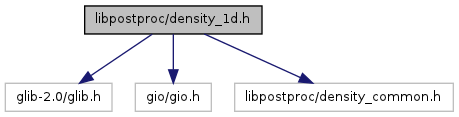
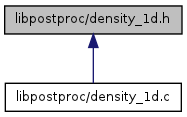
#include <glib-2.0/glib.h>#include <gio/gio.h>#include <libpostproc/density_common.h> Include dependency graph for density_1d.h: This graph shows which files directly or indirectly include this file:
Go to the source code of this file.
Classes | |
| struct | density_1d |
Enumerations | |
| enum | density_1d_distribution_hint { CONSTANT, CENTERED, ANTICENTERED } |
Functions | |
| void | init_density_1d (struct density_1d *d, double initial_value) |
| void | density_1d_mul_by_const (struct density_1d *d, double c) |
| void | density_1d_add_const (struct density_1d *d, double c) |
| struct density_1d * | new_density_1d (int N, double dx, double initial_value) |
| struct density_1d * | new_density_1d_copy (const struct density_1d *orig) |
| void | free_density_1d (struct density_1d *d) |
| int | op_density_1d_to_density_1d (struct density_1d *to, enum density_op op, const struct density_1d *from) |
| int | op_density_1d_to_density_1d_cb (struct density_1d *restrict to, const struct density_1d *restrict from, void(*callback)(int X, unsigned N, double dx, double *restrict to, double from, void *restrict privdat), void *restrict privdat) |
| double | density_1d_sum (const struct density_1d *d, enum density_1d_distribution_hint hint) |
| double | density_1d_integrate_density (const struct density_1d *d, double abserr, double relerr, double *ierr, GError **e, int filename_index) |
Density distribution hints. These help ensure numerical accuracy. constant: there is roughly an even distribution across the structure centered: there is very very little at the edges and much more at the center. anticentered: there is very little at the center and much more at the edges.
Definition at line 45 of file density_1d.h.
                                    {
    CONSTANT,
    CENTERED,
    ANTICENTERED
  };
| void density_1d_add_const | ( | struct density_1d * | d, |
| double | c | ||
| ) |
Definition at line 245 of file density_1d.c.
References density_1d::N, and density_1d::storage.
Referenced by potential_1d_get_potential_integrate().
                                                          {
  #ifdef OPENMP
  #pragma omp parallel for
  #endif
  for(long unsigned i=0; i<d->N; i++) d->storage[i] += c;
}
Here is the caller graph for this function:| double density_1d_integrate_density | ( | const struct density_1d * | d, |
| double | abserr, | ||
| double | relerr, | ||
| double * | ierr, | ||
| GError ** | e, | ||
| int | filename_index | ||
| ) |
Definition at line 171 of file density_1d.c.
References density_1d_params::d, DENSITY_1D_GERROR_DOMAIN, density_1d::dx, integrand(), density_1d::N, and density_1d::storage.
                                                                                                                                            {
  gsl_interp_accel *density_acc = gsl_interp_accel_alloc();
  /*Akima, so that it can cope with dropoffs.*/
  double* x = (double*)malloc(d->N*sizeof(double));
  if(x == NULL) {
    *e = g_error_new(DENSITY_1D_GERROR_DOMAIN, 100, "funkalicious::libpostproc::density_1d.c::density_1d_integrate_density: Failed to allocate array of x values");
    return nan("NaN");
  }
  for(unsigned i=0; i<d->N; i++) x[i] = i*(d->dx);
  gsl_spline *density = gsl_spline_alloc(gsl_interp_akima, d->N);
  gsl_spline_init(density, x, d->storage, d->N);
  free(x);
  struct density_1d_params ig = {
    .d = density,
    .d_acc = density_acc
    #ifdef DEBUG_DENSITY_1D_C
    ,
    .file = NULL,
    .count = 0
    #endif
  };
  gsl_function gsl_func = {
    .function = &integrand,
    .params = &ig
  };
  double total;
  int status=0;
  gsl_integration_workspace *w = gsl_integration_workspace_alloc(4*d->N);
  double start=0, end=d->N-1;
  for(unsigned i=0; i<(d->N+1); i++) {
    /*fprintf(stderr, "start: %u->%g\n", i, d->storage[i]);*/
    /*If we hit the end, there's no charge in the structure!*/
    if(i == d->N) return 0;
    if(d->storage[i] != 0) {
      if(i == 0) {
  start = 0;
      }else{
  start = (i-1)*d->dx;
      }
      break;
    }
  }
  for(unsigned i=0; i<(d->N+1); i++) {
    /*fprintf(stderr, "end: %u->%g\n", i, d->storage[i]);*/
    if(d->storage[d->N-1-i] != 0) {
      if(i==0) {
  end = (d->N-1)*d->dx;
      }else{
  end = (d->N-i)*d->dx;
      }
      break;
    }
  }
  /*fprintf(stderr, "start=%g end=%g\n", start, end);*/
  #ifdef DEBUG_DENSITY_1D_C
  char fn[2048];
  sprintf(fn, "density_1d_integrand_log_%d.pdata", filename_index);
  ig.file = fopen(fn, "w");
  ig.count = 0;
  #endif
  gsl_integration_qag(&gsl_func, start, end, abserr, relerr, 4*d->N, GSL_INTEG_GAUSS61, w, &total, ierr);
  #ifdef DEBUG_DENSITY_1D_C
  fclose(ig.file);
  #endif
  if(status != 0) {
    *e = g_error_new(DENSITY_1D_GERROR_DOMAIN, status, "funkalicious::libpostproc::density_1d.c::density_1d_integrate_density: Got error (status=%d) while integrating density to find total density: %s", status, gsl_strerror(status));
  }
  gsl_integration_workspace_free(w);
  gsl_spline_free(density);
  gsl_interp_accel_free(density_acc);
  return total;
}
Here is the call graph for this function:| void density_1d_mul_by_const | ( | struct density_1d * | d, |
| double | c | ||
| ) |
Definition at line 40 of file density_1d.c.
References c, density_1d::N, and density_1d::storage.
Referenced by get_potential_for_density_1d().
Here is the caller graph for this function:| double density_1d_sum | ( | const struct density_1d * | d, |
| enum density_1d_distribution_hint | hint | ||
| ) |
Gets the sum of the density, using distribution hint.
Definition at line 127 of file density_1d.c.
References ANTICENTERED, CENTERED, CONSTANT, density_1d::N, and density_1d::storage.
                                                                                          {
  double total = 0;
  unsigned i;
  switch(hint) {
  case CONSTANT:
    for(i=0; i<d->N; i++) total += d->storage[i];
    break;
  case CENTERED:
    for(i=0; i<(d->N - (d->N%2))/2; i++) {
      total += d->storage[i] + d->storage[d->N-1-i];
    }
    if((d->N%2) != 0) total += d->storage[(d->N - (d->N%2))/2];
    break;
  case ANTICENTERED:
    if((d->N%2) != 0) total = d->storage[(d->N - (d->N%2))/2];
    /*The -1 is because (N-N%2)/2 is the *center* point (if odd; if even, it is the last point on the opposite side!)*/
    for(i=((d->N - (d->N%2))/2-1); i>=0; i--) {
      total += d->storage[i] + d->storage[d->N-1-i];
    }
    break;
  default:
    return nan("NaN");
  }
  return total;
}
| void free_density_1d | ( | struct density_1d * | d | ) |
Definition at line 74 of file density_1d.c.
References density_1d::storage.
Referenced by get_potential_for_density_1d(), potential_1d_get_dfield_integrate(), potential_1d_get_potential_from_dfield(), and potential_1d_get_potential_integrate().
                                           {
  free(d->storage);
  free(d);
}
Here is the caller graph for this function:| void init_density_1d | ( | struct density_1d * | d, |
| double | initial_value | ||
| ) |
Definition at line 34 of file density_1d.c.
References density_1d::N, and density_1d::storage.
Referenced by new_density_1d().
Here is the caller graph for this function:| struct density_1d* new_density_1d | ( | int | N, |
| double | dx, | ||
| double | initial_value | ||
| ) | [read] |
Definition at line 46 of file density_1d.c.
References density_1d::dx, init_density_1d(), density_1d::N, and density_1d::storage.
Referenced by get_potential_for_density_1d(), potential_1d_get_dfield_integrate(), and potential_1d_get_potential_from_dfield().
                                                                          {
  struct density_1d *d = (struct density_1d*)malloc(sizeof(struct density_1d));
  if(d == NULL) return NULL;
  d->N = N;
  d->dx = dx;
  d->storage = (double*)malloc(sizeof(double)*N);
  if(d->storage == NULL) {
    free(d);
    return NULL;
  }
  init_density_1d(d, initial_value);
  return d;
}
Here is the call graph for this function: Here is the caller graph for this function:| struct density_1d* new_density_1d_copy | ( | const struct density_1d * | orig | ) | [read] |
Definition at line 60 of file density_1d.c.
References density_1d::dx, density_1d::N, and density_1d::storage.
Referenced by get_potential_for_density_1d().
                                                                      {
  struct density_1d *d = (struct density_1d*)malloc(sizeof(struct density_1d));
  if(d == NULL) return NULL;
  d->N = orig->N;
  d->dx = orig->dx;
  d->storage = (double*)malloc(sizeof(double)*orig->N);
  if(d->storage == NULL) {
    free(d);
    return NULL;
  }
  for(int i=0; i<orig->N; i++) d->storage[i] = orig->storage[i];
  return d;
}
Here is the caller graph for this function:| int op_density_1d_to_density_1d | ( | struct density_1d * | to, |
| enum density_op | op, | ||
| const struct density_1d * | from | ||
| ) |
Definition at line 79 of file density_1d.c.
References ADD_EQUALS, ASSIGN, DIV_EQUALS, MINUS_EQUALS, MUL_EQUALS, density_1d::N, and density_1d::storage.
Referenced by get_potential_for_density_1d().
                                                                                                          {
  if(to->N != from->N) return 1;
  #ifdef OPENMP
  #pragma omp parallel for
  #endif
  for(int i=0; i<to->N; i++) {
    switch(op) {
    case ASSIGN:
      to->storage[i]
  += from->storage[i]
  ;
    break;
    case ADD_EQUALS:
      to->storage[i]
  += from->storage[i]
  ;
      break;
    case MINUS_EQUALS:
      to->storage[i]
  -= from->storage[i]
  ;
      break;
    case MUL_EQUALS:
      to->storage[i]
  *= from->storage[i]
  ;
      break;
    case DIV_EQUALS:
      to->storage[i]
  /= from->storage[i]
  ;
      break;
    }
  }
  return 0;
}
Here is the caller graph for this function:| int op_density_1d_to_density_1d_cb | ( | struct density_1d *restrict | to, |
| const struct density_1d *restrict | from, | ||
| void(*)(int X, unsigned N, double dx, double *restrict to, double from, void *restrict privdat) | callback, | ||
| void *restrict | privdat | ||
| ) |
Allows the caller to specify a callback to perform a more advanced manipulation.
| to | density to which values are saved and from which values are drawn |
| from | density from which values are drawn |
| callback | function to call at each point |
| privdat | private data to send to the callback |
Definition at line 116 of file density_1d.c.
 1.7.3
1.7.3